
Guest blog by Maeve Hitchcock
Fish are an integral part of the Ipswich River Watershed and supporting the species that call these rivers home is one of the many reasons it is important to protect and defend the river!
“Phenology is the study of the timing and cyclical patterns of events in the natural world, particularly those related to the annual life cycles of plants, animals, and other living things. These events include the budding of leaves in spring, the arrival of migratory birds, the flowering of plants, and the onset of fruit ripening. Phenology is a vital field of ecological research that helps us understand how living organisms respond to environmental cues such as day length, temperature, and rainfall, and how climate change can impact these seasonal changes” (Why Phenology?, n.d.).
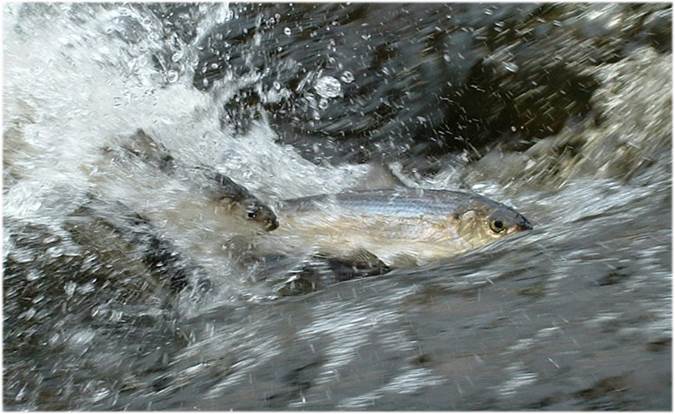
In centuries past, many different fish species were abundant throughout the Ipswich River and its tributaries. Today the list of species that you may find out on the water varies slightly from that of hundreds of years ago, but many of the same species endure – even if their populations look quite different. One such species that you probably have heard us talk about before is the alewife! Throughout the 19th century, alewives were abundant in the region but fishing and human activities in the waterways damaged their population, so much so that by 1804 their fishing had become regulated in an attempt to preserve the population (Lantagne & Morkeski, 2001). By 1834, populations of salmon and bass had become similarly scarce, and sturgeon had disappeared entirely from the waterways, by the 1880s the presence of industrial dams made passageway for both diadromous fish and other species endemic (native to and living only in a certain geological region) to the river impossible (Lantagne & Morkeski, 2001).
Diadromous fish are fish which must spend part of their lives in both fresh and salt waters. The term is an umbrella for two more specific types of migratory fish species, anadromous and catadromous fish. Anadromous fish, such as salmon and shads, move from the ocean into fresh water to spawn, while catadromous species like the American eel, do the inverse – moving from fresh water to the ocean to spawn (Lantagne & Morkeski, 2001).
Like many other migratory species, these fish rely on environmental cues such as temperature and light patterns in order to know when it’s the right time for them to begin their migration. Alterations in the timing of these environmental cues or patterns can disrupt a species normal patterns and cause some pretty serious issues. These alterations sometimes result in phenological mismatch, a phenomenon which occurs when there is a “disconnect between interacting species or between a species and its environment, where the timing of ecological events no longer aligns as it historically did (Climate Sustainability Directory, 2025)”.
This mismatch can apply to a wide range of impacts – anything from insects emerging before the plants they pollinate have bloomed, to predator species arriving before their prey and having nothing to eat. Changes in these species interactions can have a wide variety of cascading environmental impacts.
In regards to migratory fish species, we care a lot about their patterns not only because we want to see healthy population levels restored to the river but also because their “migratory patterns are essential for the transport of nutrients across marine, freshwater, and estuarine environments” (Case, 2024).
In particular, “anadromous fishes provide a unique case study for understanding phenological shifts in migration timing”, because of their complex life cycles and “high exposure to regional climate change (e.g., increasing sea surface temperature), several species of anadromous fishes have been classified as highly climate vulnerable in the northeastern USA relative to 82 coastal and marine fishes and invertebrates” (Dalton et al., 2022).
Recent open access research conducted by Dalton et al. in 2022 on the “Phenological Variation in Spring Migration Timing of Adult Alewife in Coastal Massachusetts”, provides some amazing insight into local alewife populations – including those in the Ipswich River! Their research suggests that regional run (migration) timing has remained relatively consistent over time throughout the region, despite some site specific differences. They encourage further study into alewife migration and spawning patterns and emphasize the need to develop management strategies that are informed of climate change and its impact on local species.
References
Case, D. (2024, November 12). Climate Change Impacts on Diadromous Fish Populations in the Northeast • NEIWPCC. neiwpcc. Retrieved August 1, 2025, from https://neiwpcc.org/2024/11/12/climate-change-impacts-on-diadromous-fish-populations-in-the-northeast/
Climate Sustainability Directory. (2025, February 2). Phenological Mismatches. Climate Sustainability Directory. Retrieved August 1, 2025, from https://climate.sustainability-directory.com/term/phenological-mismatches/
Dalton, R., Sheppard, J., Jordaan, A., & Staudinger, M. (2022, April). Phenological Variation in Spring Migration Timing of Adult Alewife in Coastal Massachusetts. Marine and Coastal Fisheries, 14(2). Wiley. https://doi.org/10.1002/mcf2.10198
Lantagne, D., & Morkeski, K. (2001). Freshwater Fish: A Guide to the Fishes of the Ipswich River.
Why Phenology? (n.d.). USA National Phenology Network. Retrieved July 31, 2025, from https://www.usanpn.org/about/phenology