
Hardiness, sun-exposure, and climate zones are plant attributes that even a novice gardener has a passing familiarity with. You don’t expect to grow a cactus in a New England yard, though that could change. Impervious surfaces like parking areas, roads, and roofs have increased with development. And though Northeastern Massachusetts is studded with conservation land that includes state parks, Massachusetts Audubon’s Ipswich River Wildlife Sanctuary, a National Wildlife Refuge and protected private lands the landscape has changed. In less than 10 years, 38,000 acres of land was developed. That averages as 13 acres of land per day, and the result was 50,000 acres of forest lost.
Our region developed primarily as a temperate deciduous forest with lowland marshes, swamps, and floodplain forests. Take a walk in the woods on a day with both sunshine and rain, and you can see the forests at work on our local climate and water cycle. The canopy catches and slows the rain, and where drops do pass through the branches, the soil is blanketed by a matt of leaves and held fast by wide networks of roots. As the sun comes out, and the day gets increasingly hot, the forest is cool and humid. The trees pass water from soil, to air, to canopy, and back again through evaporation, interception, and evapotranspiration. More water infiltrates through the soil, flowing downwards to recharge the aquifer or reach the river.
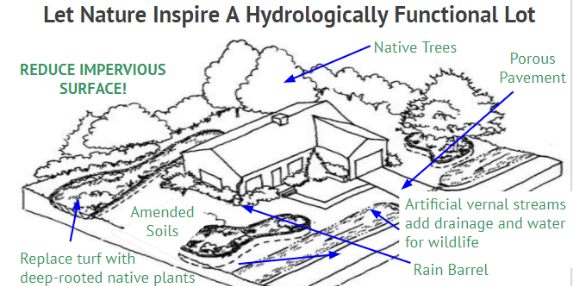
The ingenious water works of a riparian forest have been largely outed, not only by hard top, but turf grass. As it doesn’t provide shade, has extremely short roots, and loses far more water to evaporation than it absorbs or filters into the ground, turf grass may as well be a desert. “We need to create hydrologically functional yards,” says Outreach Manager Rachel Schneider who presented at the Hamilton-Wenham Garden Club’s Conservation Expo on February 24th. The Greenscapes Guide co-created with Greenscapes Coalition partners Salem Sound Coastwatch and Merrimack River valley Planning Council offers advice on how to achieve this, but Rachel also suggests, “next time it’s raining, take a walk around your property. Notice where water goes, where it tends to pool or areas it might be eroding. Don’t fight nature, pay attention to what it’s already doing.”
If you are intrigued by the concept of a hydrologically functional yard, take the first step with the Lawn by Lawn pledge below. Making chemical-free, drought-resistant yards the norm is the first step to restoring the natural systems of our neighbors. The result will be cleaner water, flowing streams, healthy wildlife, and beautiful communities.
It’s exciting to have Niel as restoration Director. I remember him from the Doyon school
I would like an opportunity to volunteer for IRWS. I have expressed this in the past but did not receive feedback.
Hi Mary! Please reach out to Ryan O’Donnell, our programs manager and make sure to fill out the Volunteer Inquiry form. Thank you!
You should also be promoting deer hunting. The deer are an enormous menace to the deciduous forests of Massachusetts. Probably the biggest, second only to unplanned development.