
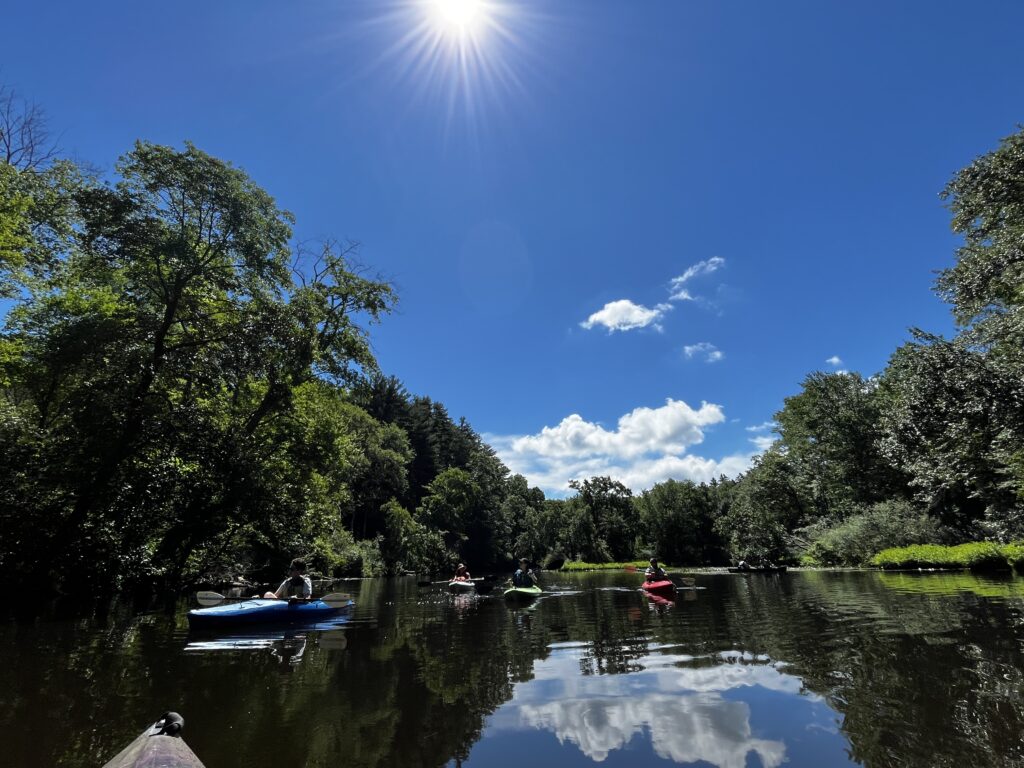
This summer, IRWA River Ambassador Ally Krohg brought her studies in Environmental Science and Indigenous Studies to the Ipswich River. As part of her internship, Ally researched and drafted a new Land Acknowledgement for IRWA—work that not only deepens our understanding of the river’s history, but also begins to tell the fuller story of the people who lived along the Agawam (now Ipswich) for millennia before colonization. In this blog post, Ally shares her research on the Pawtucket people, the impacts of colonization, and why acknowledging this history matters today.
We acknowledge that before colonial settlers renamed this river the Ipswich, it was called the Agawam. The river lies within the homelands and unceded territories of people the colonial government called Pawtucket (Puh-tuck-it). Although we do not really know what they called themselves, likely Ninnuock (nin-oo-ock), “the people here”, the community is commonly known as the Pawtucket which roughly translates to “at the falls on the tidal river”.
The Pawtucket were patrilineal bands of the Pennacook community who expanded south from lower New Hampshire. They spoke a Western-Abenaki dialect of the algonquian language and migrated seasonally between their main village in Wamesit (Wah-me-sit), now Lowell and villages along the now Essex County coast.
The Pawtucket people shared deep kinship relationships with the water, wildlife, and entire environment. Although they related to the Agawam through travel, agriculture, and fishing, they did so in a way that honored the natural systems and maintained ecological balance. For example, fishing was not merely a source of sustenance, but also a vital part of their cultural identity, traditional practices and education, and economy and politics. Before the colonists arrived with a consumptive and extractive mindset, the river burst with life; estimates suggest that the annual herring run once numbered between one and four million fish.
The real history of this land is hidden across New England, but we want to recognize the genocide that happened here. The Pawtucket were agriculturalists and did not possess firearms, which left them at an extreme disadvantage in relation to both their native enemies and the colonists. During and after King Philip’s War, survivors identifiable as “Indians,” meaning any men, women, or children who appeared to be Native Pawtucket people, were confined to internment camps and many were shipped to Bermuda and Barbados as slaves. Later, between 1700 and 1750, the government of the Massachusetts Bay Colony offered bounties for the scalps of Native people as part of a larger, state-supported effort to erase all Native people and stories from this land.
The violence and forced displacement led many Pawtucket and other Native people to lose their homes, possessions, gene pools, kinship relationships with their homeland, and identities as Native Americans. As a result, many descendants of the Pawtucket today do not know who they are because their ancestors were either forced to assimilate or went into hiding and mask their identities.
Today, there are living descendants of the Pawtucket among Abenaki (a-buh-naakee), Pequaket (Pee kwot), Penobscot (Pen nob scott), and Micmac (Mee gah muh) communities in Vermont, New Hampshire, Maine, and Nova Scotia. However in Essex County there are no surviving Indigenous communities that publicly identify as descendants of those here prior to 1700.
Colonization is an ongoing process of control and continues to erase Indigenous peoples both physically and metaphorically. We must counter the “doctrine of discovery” with the true story of people who were already here. We support the descendants of Native Americans of the Northeast who are working to reclaim or reinvent their remixed Native heritage. Their story of survival, adaptation, and resilience in the face of 400 years of persecution and catastrophic change is a crucial part of the narrative that has been left out for far too long. We are starting by acknowledging this land, but we wish to repair our relationship with Native communities and with the land. We hope to educate the public and inspire ongoing action
Thank You, or as my Navajo friends say , A’ hee’hee’. I have learned so much in my 35 years of visits with the Dine’ but enjoyed reading of the people that once lived where I live. I once wrote a rebuttal editorial after a few hikers on the Bay State Trail in the Georgetown area wrote an article for our newspaper making great mention of the plaques denoting areas of “Slaughter” of white families by the Indians”. I presented in my article some accurate history including the words of the plaque mounted in the state house back then announcing the reward for Indian scalps, including those of children. This history is so important, and as you write, there are no living tribal members still here to bring it forth. Excellent, I look forward to more history of the native people, especially as they interacted with the Ipswich River. As I used to dig clams, my old friends and I would often talk of those that were here before us as we dug. We appreciate you writing this story.