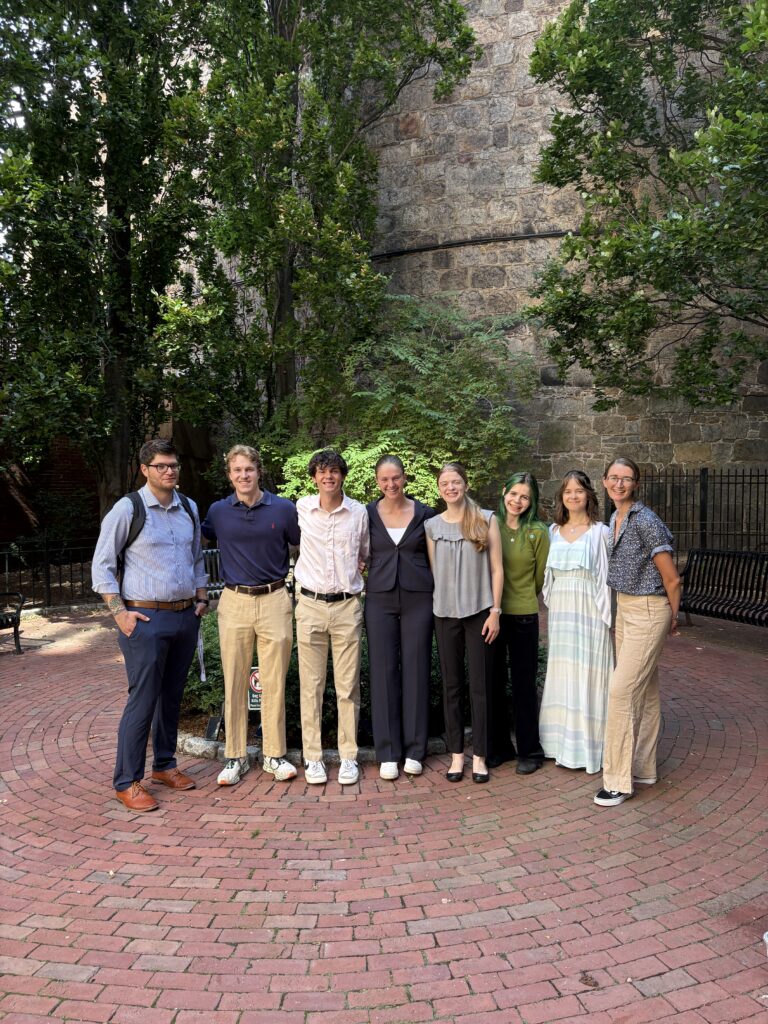
Our recent State House Field Trip was a wonderful opportunity for us to learn more about the legislative process in Massachusetts and gain some experience advocating for policy. We had a great time touring the State house, watching a senate session, and meeting with our elected officials or their staffers to discuss the bills we researched.
Here’s a bit about what we each got up to!
Maeve: I was able to meet with Senator Crighton’s Legislative Director Alex Chilton to ask for support on Bill S.644, “An Act Restricting The Use Of Rodenticides In The Environment”. This bill focuses on further restricting how harmful chemicals like those known as “second generation anticoagulant rodenticides”, or SGARs for short, can be used. These chemicals present a major threat to wildlife health as birds and large mammals can become very sick or even die when they prey upon rodents who have already consumed these rodenticides. I first learned about this issue after attending a raptor program at the Parker River National Wildlife Refuge a couple years ago where the educators told us that consuming rodenticides is actually one of the primary reasons birds of prey end up in wildlife rehab facilities! Outside of the state house, action is being taken by the local conservation organization Earth Wise Aware who have recently launched a whole campaign against these poisons. If you are interested in learning more you can check out their advocacy work and the open database they have built about local rodenticide usage/incidents here!
Aidan: Although I was not able to secure a meeting with Senator Tarr, I was still able to learn about Bill S.2187, “An Act prohibiting state and municipal contracts for the purchase and installation of artificial turf fields”. This has been a topic of heated debate in our area, with the local school district Masconomet looking to install two artificial turf fields of their own. There had been many concerns such as the effects of microplastics leaching into the river, the dangerous effects of repeated impacts sustained by athletes, and the mysterious dangers of PFAS chemicals. Learning about this bill gave me hope that many people shared this concern, and I hope that it is one that the government could take into consideration in the near future.
Declan: For our visit to the State House, I decided to center my research around Bill S.599, “An Act to overcome coastal and environmental acidification and nutrient pollution”. This bill was presented by my own state senate representative, Dylan Fernandes, and aims to create a council of stakeholders throughout the state to help address ocean acidification and nutrient pollution. This bill is very important in my home town on Buzzards Bay because nitrogen pollution has been a consistent threat to the bay’s health for my entire life. Our visit gave me an excellent opportunity to learn more about how these bills are created, proposed, and implemented through the legislative process. I am looking forward to continuing to engage in local and statewide politics in my community, and I am hoping to meet with Senator Fernandes in my own time to learn even more about his approaches to environmentalism in government.
Alice: I chose to focus on Bill S.586/H.1003 – “An Act relative to maintaining adequate water supplies through effective drought management.” This bill proposes the addition of Section 2B to Chapter 21A of the General Laws, which would establish a permanent Drought Management Task Force within the Executive Office of Energy and Environmental Affairs. As someone passionate about environmental sustainability, I found it exciting to see a proposed framework that emphasizes proactive, science-based drought response. The bill outlines how this task force would bring together representatives from key state agencies and organizations to coordinate responses during droughts, develop a comprehensive drought management plan, and issue conservation measures when necessary. I was particularly interested in how it would empower the secretary to enforce water conservation at the regional level, recognizing the unique needs of different watersheds across Massachusetts.
Ally: I am thankful for the opportunity to visit the Massachusetts State House earlier this summer! After our tour in the morning, we watched my hometown’s senator, Bruce Tarr, in session. Then later in the day I got to meet with Senator Tarr to express my support for the Bill H.3998 “An Act relative to promoting native plantings for stormwater management, pollinator support and climate resilience”. I explained how plants naturally act as filtration systems, so planting them near water ways can help protect our watersheds. We also discussed how this simple solution can decrease climate change because plants sequester carbon through photosynthesis and pollination of native plants is essential for biodiversity and a healthy ecosystem. Senator Tarr appreciated my passion for environmental advocacy and agreed that this bill offers a powerful, accessible step in global environmental challenges. I emphasized how community engagement and education are critical components of Bill H.3998, making it not just environmentally impactful but also inclusive and empowering for people of all identities across Massachusetts. Overall, it was a meaningful experience that taught me about advocating for environmental policy at the state level. I’m excited to continue this work and to inspire others to take action for the health of our planet.
Hannah: During our State House Visit, I focused on bill H.3999 “An Act relative to establishing accountability for stormwater runoff mitigation and watershed restoration.” Where I am from, in Lynn, Kings Beach suffers from intense water quality issues related to stormwater runoff and Combined Sewer Overflows. I chose to focus on this bill because of its urgency and relativity to the legislator I was able to meet with. During my meeting with Rep. Daniel Cahill and his legal counsel Schuyler Hogan, I was able to touch on issues relating to both our local watershed and the many watersheds across the state that could be aided with improved legislation. In Lynn, stormwater runoff exiting through the Stacy’s Brook outfall has created unsafe levels of bacteria in Kings Beach, leading to frequent beach closures. Unfortunately, these closures are enforced with a flag system, and many residents still swim in the water even when it is deemed to be a health risk. As climate change continues to affect weather events, it is predicted that such issues pertaining to stormwater will continue to become more severe and pose more risks to the public. My representative was receptive to the issues I presented, asked meaningful questions, and shared in my hope for a better future for Kings beach. I found our visit overall to be very informative, and I am glad that I was able to become better educated on my local legislative process!
Maya: At our State House visit, I met with Representative Cahill’s legal counsel, Schuyler Hogan, and discussed bill H.1046, “An Act to eliminate combined sewer overflows in Massachusetts waterways”. Coincidentally, Rep Cahill’s legal counsel was from a similar area of Lynn, and he was very intrigued to learn about how combined sewer overflows affect our local beach, Kings Beach. We both grew up avoiding Kings Beach, for combined sewer overflows resulted in exceedingly high bacteria levels. As a result, he left the meeting motivated to help clean up the beach, just as Representative Cahill is. I was also able to talk with Representative Cahill on zoom, and his comprehensive knowledge of this issue was good to hear. The high cost of many possible solutions as well as a lack of support from the neighboring town make the Kings Beach situation a difficult one, but it’s good to know there are people at the state level who recognize the importance of it.